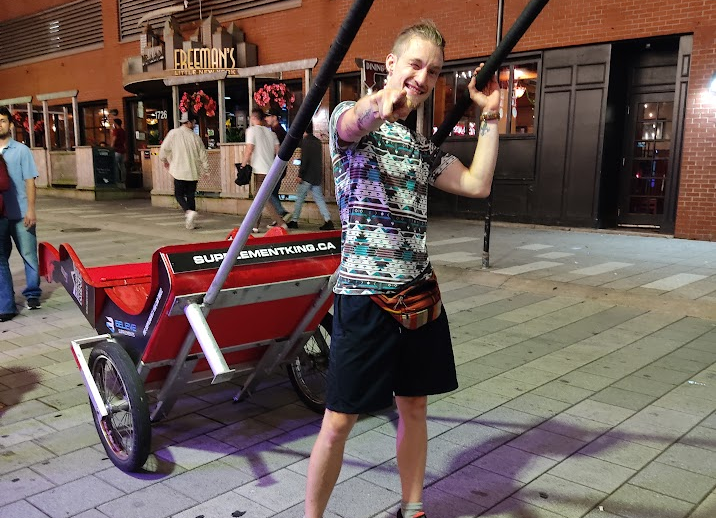


Having re-engineered the traditional rickshaw and re-designed his business model, Simon Herbinger is envisioning Rickshaw Collective franchises across Canada and internationally.
Herbinger incorporated Halifax-based Rickshaw Collective in 2023. The company has recently expanded to the city of St. John’s, taking their lightweight rickshaws to popular George Street and the pedestrian mall on Water St. Their rickshaws will also return to Halifax streets along with the summer sun.
Herbinger sees his business as both a return of a traditional service and a re-imagining of it. He told Entrevestor that rickshaws were a recognizable part of downtown Halifax culture in the 1990s and early 2000s, particularly in nightlife and tourism, but after the pandemic, the industry nearly disappeared locally.
“Rickshaws create memorable social experiences that are real. They enable inclusivity, accessibility and promote community,” he said.
A mechanical engineer by training, Herbinger said he has rebuilt the classic rickshaw. His modern design uses lightweight aluminum and carbon-fibre. He is currently working with Dalhousie University mechanical engineering students on a dual hydraulic disc brake system.
Rickshaw Collective also operates as a mobile marketing platform. The company has partnered with sponsors such as Supplement King, Magnetic World and Purple Cow, participated in events such as the Apple Blossom Festival and Parade of Lights, and has rented rickshaws for TV productions, including This Hour Has 22 Minutes.
Herbinger plans to design lightweight LED billboards, add electric motor assist, and an app to automate scheduling.
“Rickshaw Collective marks a shift from informal street service to engineered, eco-friendly urban mobility and entertainment platform,” he said.
Seeing opportunity in an old idea, the company has redesigned the employment and revenue structure to make it easier and more flexible for workers to pull rickshaws. Runners can make $10,000 to $30,000 a season, Herbinger said.
“We’re providing flexible, low-barrier, highly paid work for casual operators. The work is fun, social and a workout.”
So far, the venture has been bootstrapped by Herbinger with money he inherited from his grandfather. He said he may need to raise funds when he tackles scaling across Canada.
Competition is not fierce, he said, as the pandemic led to a decline in hand-held rickshaws.
Ultimately, he would like to sell fleets of rickshaws through a franchising model, with recurring revenue available through franchise fees and expanded marketing deals.
Herbinger began working as a rickshaw runner in 2017, while still a student. His current business partners include the previous owner of a 2010's rickshaw business in Halifax and another former rickshaw runner.
He previously ran a company called Remote Energy Systems which created foldable solar panels for sailboats.
With five co-founders (all young engineers), that venture ran out of money after they spent too much time on research and not enough on moving the business forward, he said.
That experience helps him with managing the new business. He said his company’s greatest problem is probably the negative perceptions of rickshaws that some people hold.
“There can be resistance to rickshaws on public streets and waterfronts. There can be a perception of operators as rogue-like and unprofessional. But our staff are professional, well-trained, and our rickshaws well-designed prioritising safety. We offer accessible tours at a walking pace.
“Rickshaws can be the heartbeat of downtown," he added.